 Navier Stokes Explained for iPhone
See the Navier–Stokes equations move.
A real 3D fluid simulation in your pocket. Pour, stir and tilt a tank of water, then watch each term of the equations push it around.
Download on the App StoreFree · iPhone · iOS 18 or later · Works offline · No account
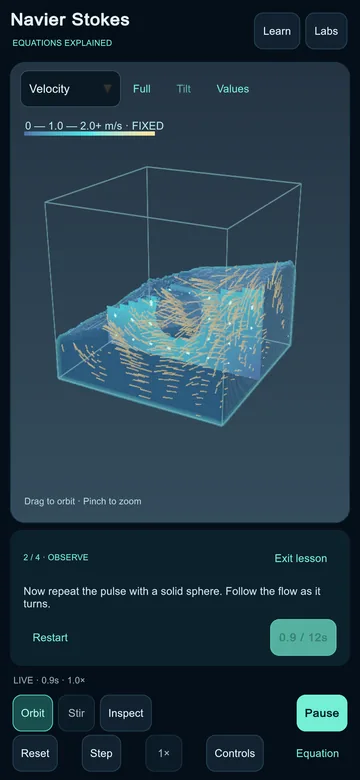
The idea
What are the Navier–Stokes equations?
The Navier–Stokes equations describe how liquids and gases move: water in a glass, air over a wing, blood in an artery, weather around the planet. Claude-Louis Navier and George Gabriel Stokes wrote them down in the nineteenth century, and they are still how engineers and scientists predict flow today.
At heart they are Newton’s second law, F = ma, applied to a tiny parcel of fluid. The left side says how the parcel’s motion changes. The right side lists what pushes it: pressure, the fluid’s own internal friction, and outside forces such as gravity. A second, shorter equation adds that water cannot be squashed.
∂u/∂t + (u · ∇)u =
−∇p/ρ + ν∇²u + f
∇ · u = 0
- ∂u/∂t
- Acceleration. How velocity changes at one spot from moment to moment.
- (u · ∇)u
- Advection. Moving water carries its own motion along.
- −∇p/ρ
- Pressure. It pushes water from high pressure toward low.
- ν∇²u
- Viscosity. The liquid’s internal friction smooths motion out.
- f
- Outside forces. Gravity, and your finger when you stir.
- ∇ · u = 0
- Incompressibility. Water does not squash: what flows in must flow out.
Nobody has a general formula that solves them. Whether smooth solutions always exist in three dimensions is one of the Clay Mathematics Institute’s seven Millennium Prize Problems, with a million-dollar prize still unclaimed. So in practice computers solve them approximately, step by step. That is exactly what this app does, live, on your iPhone, where you can poke at the result.
The app
From a wall of symbols to something you can watch
-
See
Color the water by speed, pressure or rotation. Add velocity arrows and tracer trails, and watch each term at work in a falling column, a stirred tank and a flow past a sphere.
-
Measure
Tap anywhere to place a probe, then open Values: every term of the equation becomes an arrow and a number at that point. In still water the pressure arrow and the gravity arrow cancel exactly.
-
Learn
Four short lessons, one term at a time. Predict what will happen, watch it, compare two runs on a chart, then read why.
-
Tilt
Turn on Tilt and gravity in the tank follows your phone. Turn it upside down and the water falls to the ceiling.
Guided lessons
Four questions, answered by experiment
-
Why does a swirl fade?
The same stir in two liquids, ten thousand times apart in viscosity.
-
What holds water up?
Measure pressure at two depths and see its gradient balance gravity.
-
How does flow turn?
A pulse of water meets a solid sphere. Follow the tracers around it.
-
Why doesn’t water squash?
Drop the same column twice, once with the pressure solve switched off.
Screenshots
A lab, not a video
Gravity, viscosity and stirring strength are yours to change, with a live Reynolds number. Pause, single-step or run at half speed. Everything below is the app running, not an animation.
-
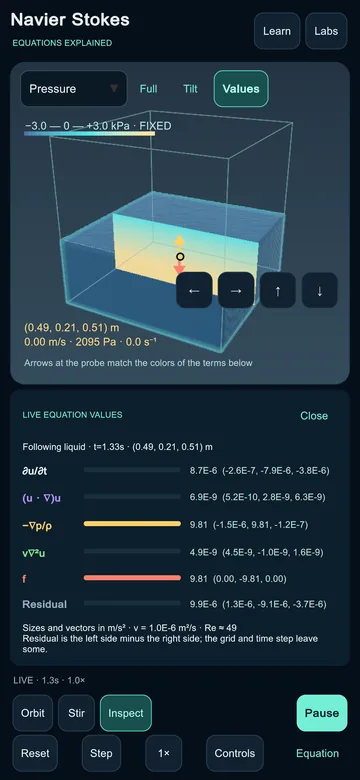
Every term as a bar, a vector and an arrow at the probe. -
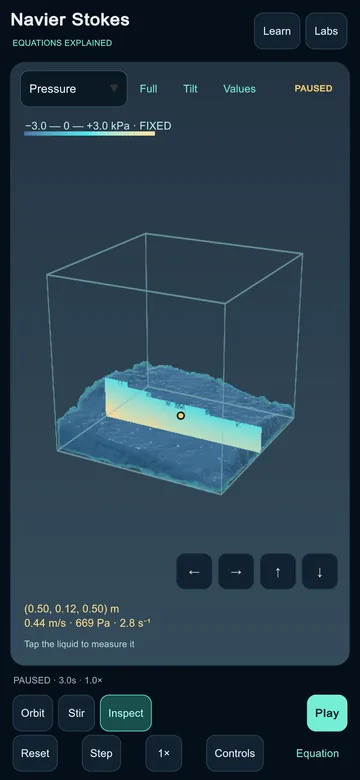
A pressure slice with a probe you can move. -
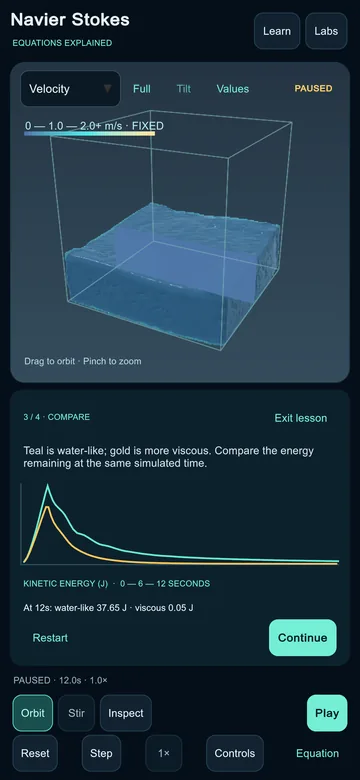
The viscosity lesson: two liquids, one chart. -
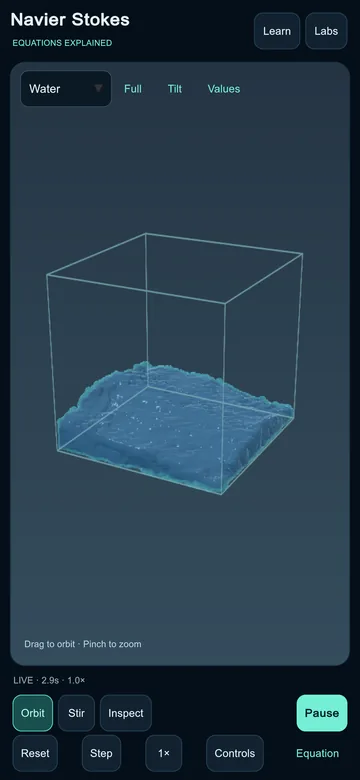
The falling column, a moment after the splash. -
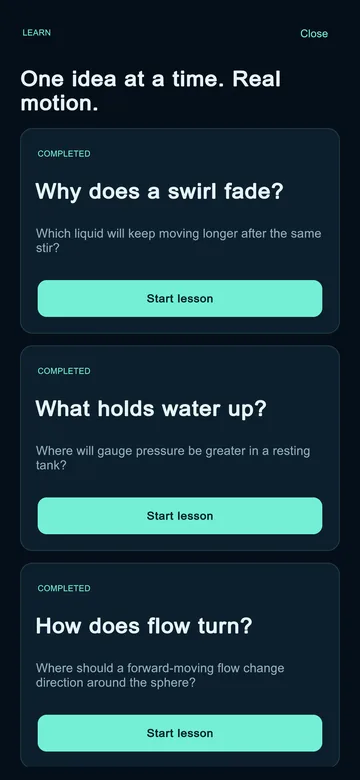
One idea at a time.
Honest about its limits
A teaching tool, not an engineering one
This is an approximation on a coarse grid, and it says so: measurements near boundaries are labeled as estimates, and the numerical error left over by the grid and the time step is shown right beside the terms. It is built for understanding, for students, teachers and the curious. It must not be used for engineering measurements.
Questions
Frequently asked
Is Navier Stokes Explained free?
Yes. It is supported by ads on menu screens and between activities. Lessons and the simulation itself are never interrupted, and there is no account and nothing to buy.
Which iPhone do I need?
An iPhone running iOS 18 or later. The simulation runs on the phone’s GPU, so a recent model gives the smoothest water.
Does it work offline?
Yes. Every lesson and experiment works without a connection.
Do I need to know calculus?
No. Every term opens a plain-language explanation and an experiment to try, and the first launch walks through the equations out loud. The symbols are there for when you want them.
What data does the app collect?
The app itself collects nothing. Advertising is provided by Google AdMob; the details and your choices are in the Navier Stokes Explained privacy policy.
How do I get help or send feedback?
Write to app-support@kingofthehour.com.